
Taming the Turf Wars: Green Lawn Care Strategies

Subverting the Dominant Paradigm
The true history of the American lawn is one that I am guessing very few of those who spend their Saturdays cutting, prepping and primping their emerald outdoor carpets are aware of, much less those who outsource lawn care to professional landscapers. It is a story that nearly all of us have bought into without much thought. Even those ‘low-class’ citizens who eschew lawn care and grudgingly cut the grass only when city inspectors show up are only forced to comply with this truly American paradigm. While acknowledging the practical qualities of lawns as recreational spaces for kids and families, the depth of our universal belief that every home needs a well-maintained lawn is arguably obsessive. The clever marketing campaign foisted on us decades ago by suburban style-meisters and a growing lawn care industry has us hypnotized by the promise of, and indeed the necessity of, a golf course-like fairway surrounding our homes. The story of how we got here is interesting, and a little comical as well.
Lawns of the Rich & Famous
Lawns first arose in 17-century Europe, staples of the expansive estates of nobility, people who had more land than they truly needed but also needed to maintain an image. These green expanses looked nothing like the modern lawn, as they were maintained primarily by sheep, along with the toiling of slaves or low-wage labor. Aristocrats in the newly minted United States sought to mimic what they knew of in Europe. Both George Washington and Thomas Jefferson, among America’s early nobility, both maintained lawns around their estates with abundant slave labor. Lawns or ‘greens’ were also found in a few formal public spaces, maintained by manual labor using scythes. For most people; however, a lawn was not only a waste of space that could be growing food or pasturing livestock but a waste of precious labor to maintain. Although the first mechanical reel mower came out in the early 19th century in England, they were not in common use in America.


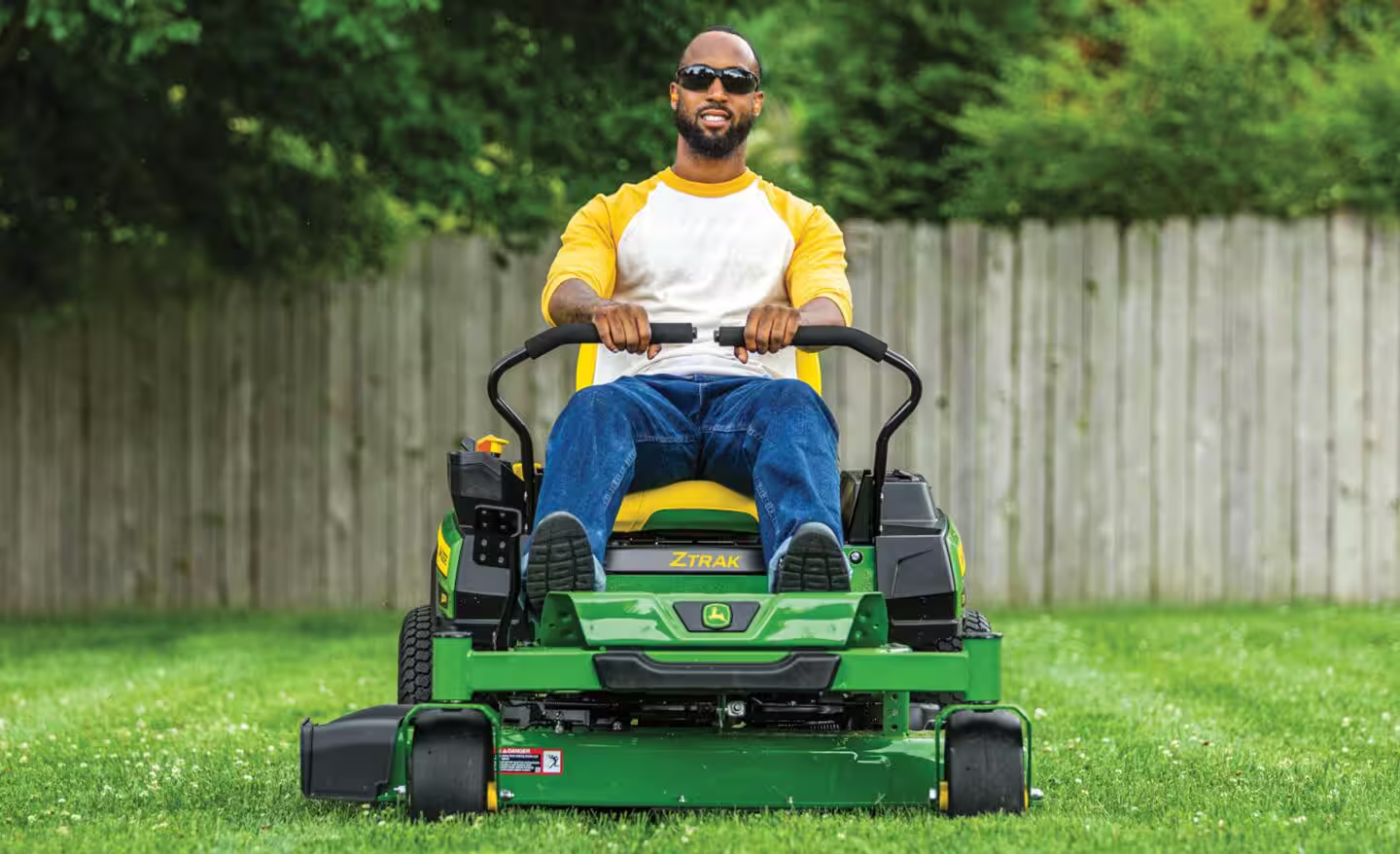
The Evolution of Lawn Maintenance Through the Years
It really wasn’t until well into the 20th century that the concept of a lawn around homes and living spaces was promoted and more widely accepted. The inspiration was again the landscapes of the wealthy, which more people aspired to. Still, lawns were tedious and laborious to maintain, and they included many plants that today are considered weeds. Early seed mixes often included clover to help add nitrogen to the soil. The post-war period of the 1950s not only saw a boom in suburban housing development but the introduction of gasoline-powered mowers, which made maintenance much easier. In addition, the new chemical fertilizer industry taking over American agriculture found a side hustle in convincing suburbanites that their lawns would benefit from their products. Lawns soon became ubiquitous parts of the new suburban landscape, although the small size of early suburban lots meant most folks had small patches of grass, not soccer pitch-sized expanses. The presence of a well-kept lawn was equated with a clean, well-ordered home and well-groomed kids.

1966 was a seminal year in the annals of the American lawn. It was this year that the PGA Masters Tournament was first televised in living color from Augusta National Golf Club in Georgia. Men all across America were provided a technicolor vision of what their lawns could become—unblemished, smooth green carpets. It was not long before this vision was heavily promoted and the modern turf maintenance industry grew dramatically. Today, with larger homes and lots in the tonier suburban enclaves, lawns have become more expansive. They are not only fixtures of the tidy suburbs, but business parks and college campuses also feel that their corporate and institutional image is reflected in the neatness of their landscapes. As many folks migrate to homes built in quieter rural enclaves, they transpose the iconic lawn onto their new farmette or homestead. The modern lawn is only secondarily a recreational landscape, athletic fields and golf courses excepted. Their primary function is to convey status, order, and industriousness. Most people would also add that they are pleasing to the eye—such is the depth of our attachment to this wholly unnatural landscape.
Sobering Statistics

Lawns today cover 40-50 million acres of America, making them the largest irrigated crop in the nation, exceeding corn, wheat, soybeans, and fruit trees in total acreage. Lawns consume 9 billion gallons of water daily. Over 90 million pounds of pesticides are applied to lawns annually, often exceeding that of commercial food crops. Lawn maintenance requires around 580 million gallons of gasoline each year, with each of those mowers producing the emissions equivalent in one hour of driving a car 350 miles. This is mainly due to the fact that emissions from mowers are not regulated in the same way that vehicle emissions are. An estimated 2.4 metric tons of fertilizer are applied to lawns annually, a fair percentage of which washes into local streams and lakes resulting in algal blooms and impaired water quality. Americans spend over $100 billion on lawn care annually.
One might argue that all of this energy and economic activity benefit our nation. That may well be among the only benefits derived, since lawns produce nothing else of value except for the aforementioned aesthetic and recreational qualities that we ascribe to them. They provide no food for humans, livestock or wildlife. They, in the case of treated lawns, provide little forage for pollinators. Furthermore, the handful of grasses making up lawns—mainly bluegrass and fescues in northern states and Bermuda grass and zoysia grass in the south—are not native to the US. These imported grasses, distinguished by their ability to form dense turf and withstand frequent mowing, are poorly adapted to many areas of the US. Those adapted to cool, wet climates are challenged by hot, dry summers. Those adapted to hotter areas of the US are also highly dependent on added nitrogen and lots of water. None of these species survive well without our added resources and attentive devotion.
One might infer from everything I’ve cited, that I hate lawns. While I’m bothered by the lack of natural benefits lawns provide and the amount of time, money and obsessive devotion we have for these iconic American landscapes, I acknowledge their useful qualities. In addition to their recreational function (one, which by the way, I rarely see utilized at the large expensive homes near me), they do have other practical uses on properties that abut wildlands. They provide a safety buffer and some protection from wildfire and ensure that ticks and wildlife don’t harbor near to the home. I’m agreeable to giving lawns their space, within limits. Much of what is maintained as lawns on large properties, both residential and commercial, could be converted to naturalized meadows, resulting in long term cost savings, improved habitat for pollinators and birds, and reduced environmental footprints.
Green Lawn Care Tips
With all of that being said, should you choose to eliminate or reduce the size of your lawn and replace your turf with native plants, you are to be applauded. Nonetheless, I know that’s not for everyone. There ARE several simple suggestions on how one can reduce the negative environmental impacts (and added expense) of lawn care, AND actually improve the health of your turf and your soil in the process.
- Mow lawns when 4-5” high and cut no lower than 3”, avoiding any mowing when the grass is wet. Mowing too short dries out the soil and encourages weed seeds to germinate. Mowing when grass is higher than 4-5” shocks the plant requiring it to recover. Mowing at this height also allows any flowering plants present to bloom.
- Use a mulching mower to return finely chopped clippings to nourish the soil, and keep blades sharpened for a clean cut.
- When watering a lawn, do so in the early morning and water deeply.
- Avoid chemical fertilizers and pesticides. These end up damaging the natural biology of your soil. If fertilizer is needed, apply only in mid-spring or autumn and use a slow-release one that is less than 30% nitrogen content. Other good options are cottonseed meal, dried poultry waste or compost.
- Accept the presence of beneficial weeds. This would include white clover, violets, and yes, dandelions. These low-growing plants will actually improve your soil over time and help feed pollinators. White clover can be seeded in to help add nitrogen to the soil. Southern Bermuda grass lawns can be seeded with clover and/or creeping thyme.
- Most lawns, especially bluegrass/fescue lawns in northern states, naturally go dormant during summer. Although letting your grass turn brown during the season you’re most likely to spend time enjoying it seems counter-intuitive, this is normal and healthy for cool-season grasses, which is what our lawns are in the northeast and Midwest. Watering throughout the summer is equivalent to putting your lawn on life-support. Dormancy is not dead! The grasses are conserving energy and waiting for cooler, wetter weather to return.
- A measure of weed reduction can be achieved by applying corn gluten meal to your lawn in spring and late summer. This natural by-product of corn syrup production inhibits weed seed germination and doubles as a natural fertilizer. It is available at garden centers.
- Be patient! Green lawn care doesn’t produce immediate results. It may take a couple of years to build up your soil fertility and the health of your turf.


These common ‘weeds’ actually benefit soils and pollinators.

Close-cropped grasslands/lawns consisting of just a couple of grass species don’t exist in nature and could never survive without continual human effort and inputs. In spite of how enamored we’ve become of our perfect lawns in America, it is an aesthetic and impulse worth reconsidering or at minimum restraining/downsizing. In a world where water and other resources will become more limited, it will become harder to justify maintaining a perfect lawn. This awareness has already become the norm in many arid parts of the country, particularly the desert Southwest, where city ordinances often prohibit planting water-hungry lawns in new developments. A part of becoming a more sustainable society will need to include reassessing and modifying those habits and practices that are unsustainable. Even if we feel that we can afford the expense of maintaining a little piece of golf course heaven around our homes, ultimately, the natural world can’t.
